

Book Before the Rush.
Winter changeover in south Edmonton. Book in early October and pick your day — wait for the first snowfall and so does everyone else.
Winter Tires & Seasonal Changeover in Edmonton
Book early. That is the single most useful thing on this page.
Changeover season in Edmonton compresses into about three weeks in late October and November, and every shop in the city fills up at the same time. The people who call the morning after the first real snowfall are the people waiting a week for an appointment, driving on summers in the meantime. Call 780-468-3052 in early October and you pick your day.
A & R Automotive has been swapping tires at 2687 96 Street NW since 1987 — thirty-eight Edmonton winters. AMVIC licensed, NAPA AutoPro, AMA/CAA approved.
When Should You Put Winter Tires On?
When daytime highs are consistently at or below 7°C. In Edmonton that is usually the second or third week of October, well before the first snow.
Seven degrees is not a snow threshold, it is a rubber threshold. Below it the compound in an all-season tire hardens and loses grip on dry pavement, before ice or snow enters the picture at all. That is why waiting for snow is the wrong trigger — the tires have already stopped working properly by the time it arrives.
Going the other way, take them off when nights are reliably above freezing — normally mid-April. Running winter tires through a warm spring wears the soft compound down fast and you lose a chunk of their life for no benefit.
Do You Legally Need Winter Tires in Alberta?
No. Alberta has no law requiring winter tires, and we would rather say that plainly than imply otherwise to sell a service.
If you drive to British Columbia, that changes. BC requires winter tires or chains on most designated highways from 1 October to 30 April, and to 31 March on routes that do not run through mountain passes or high-snowfall areas. The legal minimum there is either the three-peak mountain snowflake symbol or an M+S marking, with at least 3.5 mm of tread — so a decent all-season technically qualifies, though it is not what we would want to be on going over the Coquihalla.
Some insurers offer a discount for running winter tires. It is worth a phone call to your broker before you buy.
Winter, All-Weather or All-Season?
This is the decision that matters, and the naming is genuinely misleading. Here is the short version.
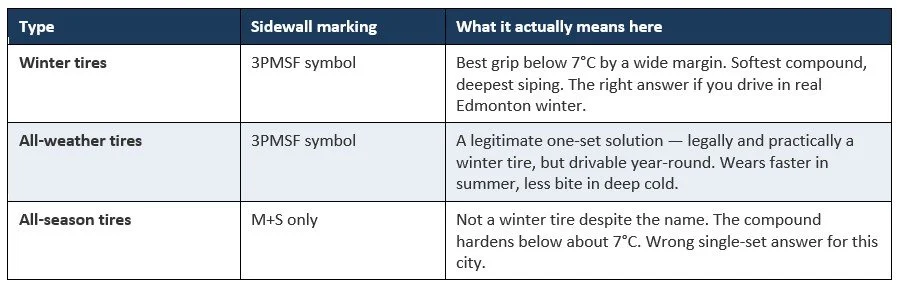
The symbol to look for is the three-peak mountain snowflake — a small pictogram of a mountain with a snowflake inside it, on the sidewall. It means the tire has been tested and certified for severe snow service. M+S alone is a manufacturer's self-declaration with no test behind it.
So which should you buy?
If you keep two sets and swap them, dedicated winters are the better tire and it is not close in deep cold. Each set also only wears half the year, so over the life of both sets it is often cheaper than it looks.
If you genuinely will not deal with swapping twice a year, all-weather is a legitimate answer rather than a compromise — a properly rated all-weather tire is far better in January than an all-season and it is legal for BC highways. Accept that it will wear faster in July and will not match a true winter tire at minus thirty.
If you are driving on all-seasons through an Edmonton winter, you are on the wrong tire. We will say that once and then leave it with you.
Studded Tires
Alberta has the most permissive studded tire rules in Canada — there are no seasonal restrictions at all and they can be run year-round, though the province asks that they be used only when conditions warrant, and damaging the road surface with studs is an offence.
Studs help on glare ice and hard-packed snow, which Edmonton produces plenty of. They are noisier, slightly worse on bare dry pavement, and modern studless winter compounds have closed much of the gap. For most city drivers a good studless winter tire is the better all-round choice. If you regularly park on an ice rink of a back lane, or drive rural roads that do not get sanded, studs still earn their keep.
One thing to note if you travel: BC restricts studs to 1 October through 30 April and requires them on both axles if fitted to the front. Alberta's rules do not follow you across the border.
What Changeover Costs and How Long It Takes
If your winters are on their own rims, changeover is a wheel swap and a re-torque — about thirty to forty-five minutes, at $XX.
If the tires need to come off the rims and go back on, that is a full mount and balance on four wheels, closer to an hour and a half, at $XX. Tell us which when you book and we will give you an accurate time rather than an optimistic one.
We re-torque your wheels free afterwards. Wheel nuts settle in the first hundred kilometres, re-torquing takes five minutes, and it prevents a genuinely serious problem. Bring it back in a week and we will do it while you wait — whether or not you paid us for the swap.
Winters on Their Own Rims
If you plan to keep the vehicle more than two winters, buy the steel rims. It costs more once and saves money every changeover after that.
A wheel swap is faster and cheaper than a full mount and balance, so the rims pay for themselves across a few seasons. You also stop breaking the tire beads twice a year, which is what eventually causes those slow leaks on alloy wheels after salt has pitted the bead seat. And steel takes a pothole hit far better than an alloy does.
We would put winters on steel and keep your alloys for summer nearly every time.
How Long Do Winter Tires Last?
Six to eight seasons for most drivers, but tread depth is only half the story.
A winter tire is finished as a winter tire well before it is legally bald. Once the tread is down to about 5 mm the snow and ice performance falls off sharply, even though there is plenty of rubber left by summer-tire standards. That is the point to replace them, not at the legal minimum.
Rubber also hardens with age regardless of use. A winter tire more than about six years old has lost a meaningful amount of its cold-weather grip even if it looks nearly new — which is worth knowing if you are tempted by a lightly-used set. The manufacture date is stamped on the sidewall as a four-digit code: week and year.
We measure them at changeover and tell you honestly where you stand, including when you have another season.
Storing the Other Set
We store your off-season tires indoors, tagged to your vehicle, so the right set comes out when you book. It saves a corner of the garage and it means you never turn up for a swap having forgotten to load them into the trunk — which happens more often than you would think.
Common Questions
-
Early October for the winter swap, early April for the spring one. The three weeks after the first snowfall are when every shop in Edmonton is full.
-
No. Alberta has no requirement. British Columbia does on most designated highways from 1 October to 30 April, so it matters if you are driving west.
-
They are a legitimate one-set answer if you will not swap twice a year — genuinely rated for severe snow, unlike all-seasons. Dedicated winters are still better in deep cold.
-
Yes, with no seasonal restriction — Alberta is the most permissive province in Canada on this. For most city drivers a good studless winter tire is the better choice, but studs still win on glare ice.
-
Thirty to forty-five minutes if the winters are on their own rims. About an hour and a half if the tires have to come off the rims and go back on.
-
At about 5 mm of tread, not at the legal minimum. Below that they stop behaving like winter tires. Age matters too — over roughly six years the compound hardens whatever the tread looks like.
-
You can, but you will wear them out in about half the time and they will handle poorly in summer heat. It is a false economy in most cases.
Book Your Changeover
Call 780-468-3052 or come by 2687-96 Street NW in south Edmonton. Monday to Friday, 8:00am to 6:00pm. Book in early October and you choose your day — leave it until after the first snow and so does everybody else.