
What Your Car Actually Needs
A maintenance schedule adjusted for Edmonton winters, road salt and short cold trips — including the things we think you can skip.
Car Maintenance in Edmonton — What Your Car Actually Needs, and What It Doesn't.
Most maintenance advice is written for a climate nobody here lives in. Edmonton does something specific to vehicles: five months of road salt, temperature swings that crack things, and a lot of short cold trips where the engine never fully warms up.
This is what we actually recommend after thirty-eight winters of it, including the things we think you can skip.
The Schedule
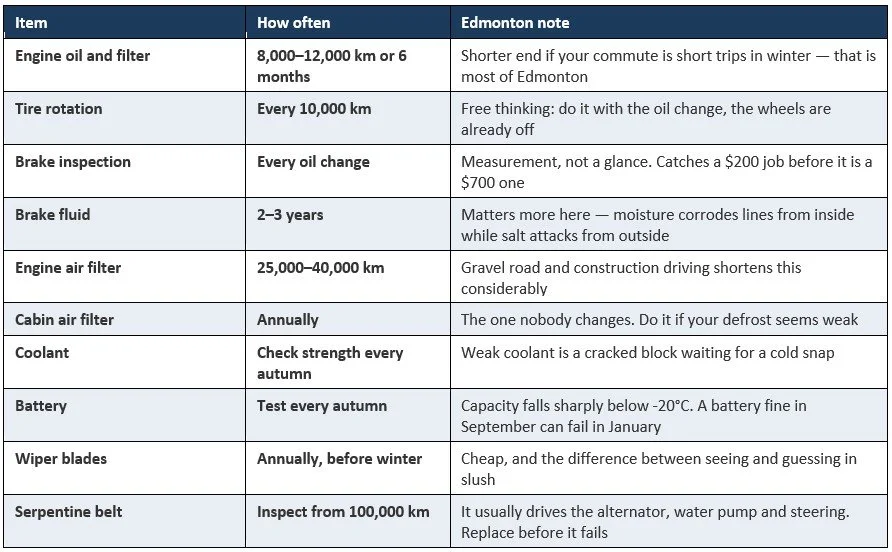
Follow your owner's manual over any shop's blanket schedule, including ours. Manufacturers test their own engines and the intervals in the book are specific to your vehicle. What the book cannot know is that you drive fifteen minutes each way in January, which is why the Edmonton notes above lean toward the shorter end.
Why Short Winter Trips Are Hard on an Engine
A cold engine produces moisture and unburnt fuel, both of which end up in the oil. On a long drive the engine gets hot enough to boil that off. On a fifteen-minute commute it never does, so it accumulates.
That is why the same car with the same mileage can need oil more often here than in a milder city, and why the 5,000 kilometre rule persisted long after synthetic oil made it unnecessary for most driving. If your commute is short and cold, err shorter. If you do highway kilometres, the longer interval is genuinely fine.
If your vehicle has an oil life monitor, trust it over any sticker or schedule. It is measuring how the engine is actually being used rather than guessing.
What to Do Before Winter
The single highest-value hour you can spend on a vehicle in this city, and best done in early October rather than after the first cold snap.
Battery. Have it load-tested. Capacity drops steeply below minus twenty, and a battery that starts the car fine in September is the one that fails in the Superstore lot in January. Testing takes minutes and is the most common preventable failure we see.
Coolant strength. Not the level — the strength. Weak or old coolant freezes, and a frozen block is an engine replacement, not a repair.
Tires. Winters on before it snows, not after. All-seasons harden below about 7°C, which is most of the season here.
Wipers and washer fluid. Use winter-rated fluid rated to at least minus forty. Summer fluid freezes in the lines and on the glass, and there is no worse moment to discover it than behind a truck on the Henday.
Brakes. Get them measured before winter rather than during. Nobody wants a brake job in February, and pads that are marginal in October will be finished by spring.
Block heater. If you have one, check the cord and that it actually works before you need it. They fail quietly.
What to Do in Spring
Spring maintenance in Edmonton is mostly about undoing winter.
Wash the underside. This is the most underrated thing on this page. Road salt does not stop working when the snow melts — it sits in the seams, on the brake lines, on the suspension mounting points, and corrodes all year. A proper undercarriage wash in spring is a few dollars and it materially extends the life of a vehicle in this city. Do it every spring without fail.
Check for pothole damage. Bent rims, damaged tires, knocked alignment, and bent suspension components. If the car has not felt right since a hard hit, it will not settle on its own.
Alignment. Worth checking after winter, because a season of potholes moves things. Uneven tire wear is the tell.
Swap the winters off. Once nights are reliably above freezing, usually mid-April. Running winter tires through a warm spring wears the soft compound down quickly for no benefit.
Wipers again. A winter of scraping ice destroys blades. They are cheap.
Road Salt and What It Does Underneath
Worth understanding properly, because it changes what matters on an older vehicle here.
Salt accelerates corrosion on everything under the car, and the components that matter are the ones you cannot see. Brake lines are steel and corrode from the outside in — a line that looks acceptable can be thin enough to burst under hard braking. Brake caliper slide pins seize, which makes one wheel drag and shows up as a pull to one side. Suspension fasteners rust solid, which is why the same repair can take twice as long here as it would somewhere milder — and why an Edmonton quote sometimes looks high compared to a number found online.
Frame rust at the suspension mounting points is the one that ends a vehicle's life. It is also the single most important thing to look at on any used car in this province, which is why it leads our pre-purchase inspection.
None of that is a reason for alarm. It is a reason to wash the underside in spring and to have somebody look underneath once a year.
What You Can Reasonably Skip
Some of what gets recommended is genuinely optional, and being told which is which is more useful than another list of services.
Engine flushes. On a well-maintained engine with a sensible oil interval, an engine flush solves a problem you do not have. There are cases for it on a badly neglected engine; there is no case for it as routine.
Fuel system cleaning as a routine service. Modern fuels contain detergents. If you have a driveability problem, diagnose it. If you do not, this is a service looking for a symptom.
Changing the oil at 5,000 km on full synthetic. Unless your driving is unusually hard or unusually short-trip, this mostly sells oil changes. The manufacturer interval exists for a reason.
Premium fuel in an engine that does not require it. If your manual says regular, regular is correct. Higher octane is not higher quality.
Nitrogen in tires. The theoretical benefit is real and, for a road car checked occasionally, negligible. Keep your pressures right with ordinary air and you get almost all of it for nothing.
We would rather tell you this and keep you for a decade than sell you a flush today.
Is It Worth Fixing an Older Car?
A question we get constantly and one worth answering without a sales angle.
The rough test: compare the cost of the repair against what the vehicle is worth and against a year of payments on something newer. A $1,500 repair on a car worth $4,000 sounds bad until you compare it with $600 a month for the next four years.
What actually decides it is usually the state of the underside. A vehicle with a sound frame, no serious rust at the suspension mounts and a healthy engine is generally worth repairing, because the expensive parts are fine and you are replacing wear items. A vehicle with frame rot is not, however well it runs, because that is not repairable at sensible cost and it will not pass an inspection.
Ask us and we will tell you straight. We have talked more than one person out of a repair and toward selling the vehicle, and that conversation costs us a job and earns something worth more.
Common Questions
-
Every 8,000 to 12,000 kilometres or six months on full synthetic, whichever comes first — shorter end if your driving is short winter trips. Follow your owner's manual over any shop's blanket number.
-
Same answer. Synthetic does not need changing at 5,000 kilometres in normal service; that interval is a holdover from conventional oil.
-
The table above covers the items that matter for most vehicles here. Your owner's manual is the authority for your specific car, and we are happy to look up the schedule for you.
-
If you keep vehicles more than a few years in this city, yes. It is the cheapest life-extension available and almost nobody does it.
-
Ask Before You Spend
If you are not sure whether something is due,call 780-468-3052 and ask. We will look it up, and if the answer is that you are fine for another season we will say so.
2687-96 Street NW, south Edmonton, Monday to Friday 8:00am to 5:00pm.