
What Is That Noise?
Clunks, grinds, shakes, smells and warning lights — what each one usually means, and whether it can wait. Most of it can.
What That Noise, Smell or Warning Light Actually Means.
Cars tell you what is wrong before they fail. The trouble is that the language is noises, smells and vibrations, and most of us were never taught to read it.
This guide covers the symptoms Edmonton drivers ask us about most, organised by what you actually notice. For each one: what it usually is, whether it is urgent, and what happens next. No scare tactics — a good half of what is on this page can wait until your next service.
If something here worries you, call 780-468-3052. We are at 2687-96 Street NW in south Edmonton and we will tell you honestly whether it needs looking at today.
First — the Short List of Things That Cannot Wait
Most car symptoms are not emergencies. These are.
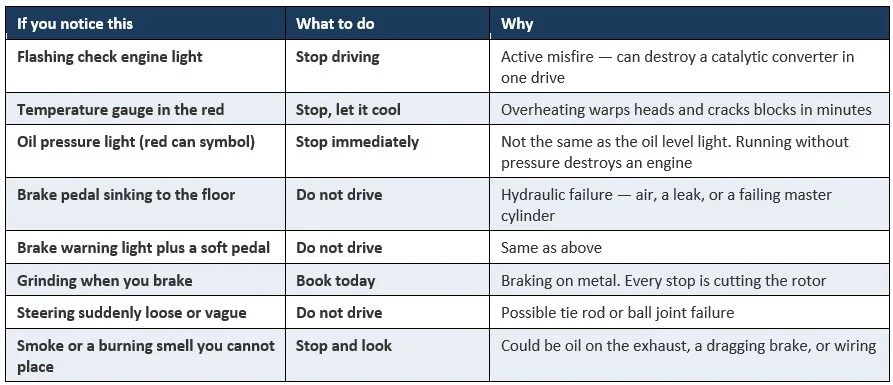
Everything else on this page falls somewhere between book it soon and mention it at your next oil change.
Noises
A hum or drone that changes with speed
Usually a wheel bearing. The tell is that it changes when you steer — swing gently left and right on an empty road and if the noise loads up one way and quietens the other, that is the bearing on the loaded side. Not urgent the week it starts, but bearings do eventually seize, so it is not a noise to live with for a year.
A clunk over bumps or railway tracks
Sway bar links, ball joints or control arm bushings, in roughly that order of likelihood. Sway bar links are the cheapest and the most common, which is the good news. Ball joints are the one that matters — a badly worn one can separate.
Creaking or squeaking over bumps
Usually dry or perished suspension bushings, or worn strut mounts. More annoying than dangerous, but it is a sign the suspension is aging and worth having looked at with the rest of the front end.
Clicking or popping when turning
Classic worn CV joint, especially if it gets louder on a tight turn in one direction. The rubber boot usually splits first, grease escapes, dirt gets in, and the joint wears out. Caught at the split-boot stage it is a cheap fix. Caught later it is a new axle.
Grinding when you brake
The pads are gone and you are braking metal on metal. Every stop from here is cutting into the rotor, so a pad job becomes a pad and rotor job and eventually a caliper job too. This is the most expensive noise on this page to ignore.
Squealing when you brake
Usually the wear indicator doing exactly its job — a small metal tab that contacts the rotor when the pad gets low. Book it in, but it is not an emergency. Squealing that disappears after the first few stops on a damp morning is just surface rust burning off.
Squealing when you start the car
Almost always a worn or glazed serpentine belt, particularly on a cold morning. Cheap to replace, and worth doing before it breaks — that belt usually drives the alternator, the water pump and the power steering.
A rattle underneath while driving
Most often a heat shield that has rusted loose — harmless, irritating, and cheap to secure. Less often it is an exhaust hanger or something in the suspension. Worth a look because the cheap version and the not-cheap version sound similar from the driver's seat.
Vibrations and How the Car Feels
Vibration at highway speed
Tire balance first — it is the most common cause by a wide margin and the cheapest to check. If a standard balance does not fix it, the next step is a road force balance, which measures the tire and wheel together under load and finds problems a spin balancer cannot see. Beyond that: a bent rim from a pothole, a worn wheel bearing, or a failing CV joint.
A vibration that appears only when braking is different — that is warped rotors, not tires.
Shaking when you brake
Warped rotors, or more precisely uneven pad material deposited on the rotor face. You feel it as a pulse through the pedal that worsens the harder you brake. Frequently caused by over-torqued wheel nuts, which is why wheels should be torqued to specification rather than run down with an impact gun.
Shaking at idle
Usually an engine misfire — a worn spark plug, a failing coil, or a vacuum leak. Sometimes a broken engine mount, which lets normal engine vibration reach the cabin. If the check engine light is on as well, the stored codes will narrow it down quickly.
The car pulls to one side
If it pulls all the time, start with tire pressures — it is free and it is the answer more often than people expect. If pressures are equal, it is alignment or uneven tire wear.
If it pulls only when braking, that is a brake problem rather than an alignment problem, usually a seized caliper on the opposite side. Common in Edmonton because road salt corrodes the caliper slide pins.
The ride has gone rough, or the car bottoms out
Worn shocks or struts. They fail so gradually that most people never notice until they drive a car with new ones. The bounce test still works: push down hard on one corner and let go. It should settle in one rebound — if it keeps oscillating, that damper is finished.
The nose dives hard under braking
Same answer — front shocks or struts. It also lengthens your stopping distance, so it is a safety item and not just a comfort one.
Smells
Burning rubber
A belt slipping, a hose touching something hot, or a dragging brake. If it comes with a hot wheel after a drive, suspect a seized caliper.
A burning smell from the engine bay
Most often oil or coolant dripping onto a hot exhaust manifold. Small leaks smell dramatic and are usually cheap. Worth finding, because the leak that smells today is the low fluid level next month.
A sweet, syrupy smell
Coolant. There is a leak somewhere — a hose, the radiator, the heater core. If the smell is strongest inside the cabin, the heater core is the likely source.
Burning after heavy braking
Normal after a long descent or hard stops, and it should fade. If you smell it after ordinary driving, a brake is dragging and needs looking at.
A rotten egg smell
Usually the catalytic converter, and often a sign it is failing or that the engine is running rich. Worth diagnosing rather than ignoring — a converter is an expensive part to replace.
Warning Lights
Check engine light — steady
Something in the emissions or engine management system has recorded a fault. Not an emergency. Book it in, and if you have had a code read at a parts store, bring the number with you — it saves time.
Check engine light — flashing
Stop driving. A flashing light means an active misfire severe enough to dump raw fuel into the exhaust, which can destroy a catalytic converter in a single drive.
Oil light
Know which one you have. A red oil-can symbol is oil pressure — stop the engine immediately, because running without oil pressure destroys an engine in minutes. A yellow or amber oil symbol on many newer vehicles is an oil level or service reminder, which is not the same thing and not an emergency.
Temperature gauge climbing
Pull over and let it cool. Do not open the radiator cap on a hot engine. Overheating is one of the few faults that can turn a moderate repair into an engine replacement in the space of a few kilometres.
Battery or charging light
The alternator is probably not charging. You are running on battery alone, which typically gives you twenty minutes to an hour. Head somewhere useful rather than continuing your day.
Tire pressure light
Check your pressures — in Edmonton this light appears across the whole city every October, because cold air contracts and a tire set correctly at plus fifteen is genuinely low at minus twenty. Set them to the figure on the door jamb sticker. If it stays on afterwards, it is a sensor rather than a pressure problem.
ABS light
Your normal brakes still work; the anti-lock system has faulted and will not assist in an emergency stop. Not a stop-driving situation, but do not leave it over winter.
Puddles and Spots on the Driveway
Colour is the quickest diagnosis you can do yourself.
Clear water is almost always air conditioning condensation and is completely normal in summer. Brown or black and oily is engine oil. Reddish and slippery is transmission fluid or power steering fluid. Green, orange or pink and slightly sweet is coolant. Clear and oily with a distinct smell is brake fluid — and that one should be looked at promptly, because brake hydraulics do not have a safe amount to lose.
Put a sheet of cardboard under the car overnight if you are not sure where it is coming from. It costs nothing and it tells us more than a description will.
Starting and Running Problems
Hard to start when cold
Very Edmonton. Usually a weak battery — capacity drops sharply in deep cold, and a battery that is fine in September can fail at minus thirty. Also worth checking: worn spark plugs, or a failing block heater if you use one.
Stalls at a stop
Often a vacuum leak, a dirty idle air control or throttle body, or a fuel delivery problem. It usually sets a code even if the light has not come on yet.
Jerks or hesitates when accelerating
Misfire, fuel delivery, or a transmission issue — and telling those apart is exactly what diagnostic equipment is for. Worth getting looked at before it strands you.
Loss of power
Could be a clogged filter, a failing fuel pump, an exhaust restriction, or the engine derating itself because of a fault it has detected. If the check engine light is on, the codes will point the way.
What to Do With Any of This
If it is on the short list at the top, deal with it now. If it is not, the sensible move is to write down what you noticed and when — at speed, over bumps, when turning, when braking, when cold — because that description narrows the diagnosis faster than anything we can do in the parking lot.
Then call 780-468-3052. We will tell you whether it needs looking at today or whether it can go on the list for your next oil change. Plenty of it can.