
Losing Air? Come In.
Proper flat repairs from the inside of the tire — not a plug pushed in from outside. Same day wherever we can.
Tire Repair in Edmonton — Flat Repairs, Mounting and Balancing
Losing air? Come in. We repair flats properly, we do it same day wherever we can, and we will tell you honestly if the tire cannot be saved rather than selling you a new one you did not need.
A & R Automotive, 2687 96 Street NW in south Edmonton. AMVIC licensed, NAPA AutoPro, AMA/CAA approved, and doing this since 1987. Call 780-468-3052 or just drive in.
What It Includes
If the tire turns out to be unrepairable we will tell you before we charge you for the attempt.
Flat Tire Repair — Done Properly
A tire repair is only safe if the tire comes off the rim and is inspected from the inside. Everything else is a temporary fix, and we do not sell temporary fixes as permanent ones.
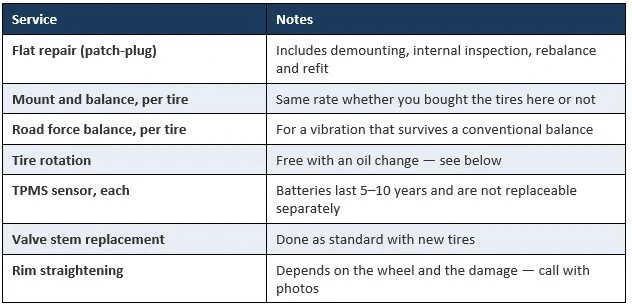
Here is what we actually do. The tire is demounted and the inner liner inspected for damage you cannot see from outside — a run-flat scuff, a separated belt, a second injury nobody noticed. The injury channel is cleaned and reamed. A combination patch-plug goes in from the inside: the plug fills the channel so water cannot reach the steel belts, and the patch seals the inner liner. Then the wheel is rebalanced, because a patch adds weight, and refitted with the nuts torqued to specification.
The alternative — a plug pushed in from the outside without removing the tire — takes three minutes and is what a lot of places do. It seals the air leak. It does not seal the liner, it does not let anyone look inside, and water tracking down the channel rusts the belts from within. That is a tire that fails months later without warning. We do not do them.
What cannot be repaired
Sidewall punctures. Shoulder punctures — anything outside the central tread area, because the rubber flexes too much there for a repair to hold. Punctures larger than about 6 mm. Any tire driven flat long enough to chew up the inner liner. And a tire that has already been repaired in the same area.
If yours is in that group we will show you the damage and explain why, rather than just handing down a verdict. Sometimes it is obvious once you see the inside of the tire.
Slow Leaks With No Visible Nail
If you are topping up every couple of weeks and cannot find a nail, the leak is almost certainly at the wheel rather than in the tread.
Three usual causes here, and all three are made worse by Edmonton winters. Valve stems perish — the rubber hardens and cracks, and a $5 part is the whole problem. Bead seat corrosion, where road salt has pitted the aluminium where the tire seals against the rim, is extremely common on alloy wheels after a few seasons; the fix is cleaning and resealing the bead, not a new wheel. And TPMS sensors have a rubber grommet that ages and a battery that eventually dies.
We find leaks by submerging the wheel rather than guessing, which takes a few minutes and removes the argument entirely. You will see the bubbles yourself.
TPMS — The Tire Pressure Light
A tire pressure light usually means exactly what it says: check your pressures. In Edmonton it comes on constantly through October and November, because cold air contracts and a tire correctly inflated at plus fifteen is genuinely low at minus twenty. Top them up and it goes out.
If the light stays on after you have set the pressures properly, or flashes for a minute at start-up before going solid, that is a sensor fault rather than a pressure problem. TPMS sensors have sealed batteries lasting roughly five to ten years and they cannot be replaced separately — when the battery dies the sensor is replaced. We can read which sensor has failed rather than replacing all four.
Sensors also need relearning to the vehicle after a changeover if you run two sets of wheels. We do that as part of the swap.
Mounting and Balancing
Mounting fits the tire to the rim. Balancing corrects the weight distribution so the wheel spins true. Done badly, you feel it in the steering wheel at highway speed, and the tire wears unevenly for the rest of its life.
We fit customer-supplied tires at the same rate as tires bought here — we are not going to charge you extra for shopping around. New valve stems go on as standard with new tires, because fitting a fresh tire to a ten-year-old valve stem is asking for the slow leak described above. Wheels are torqued with a torque wrench to the manufacturer's figure, not run down with an impact gun, because over-torquing warps rotors and that is a far bigger bill than the one you came in for.
We will also tell you if what you have bought is the wrong size or load rating for your vehicle before it goes on. That conversation is easier before the tires are mounted than after.
Vibration That Will Not Go Away
If a standard balance has not fixed a highway-speed shake, the next step is a road force balance.
A conventional spin balancer measures weight distribution. A road force balancer presses a loaded roller against the tire while it spins, simulating the weight of the vehicle, and measures how the tire and rim behave together under load. It finds stiffness variation in the tire carcass and runout in the rim — problems that are invisible to a spin balance and account for most vibrations that survive one.
It also tells us whether the tire or the wheel is at fault, and often the fix is simply rotating the tire on the rim to a better position rather than replacing anything. Worth knowing before someone sells you four new tires for a vibration.
Pothole Damage
Spring in Edmonton is hard on tires, and the search data agrees — tire repair enquiries here run at nearly three times the January rate by May. A hard pothole hit can do several things at once and it is worth having all of them looked at together.
A bent rim will not hold a bead properly and shows up as a slow leak or a vibration; many are straightenable rather than write-offs. A sidewall bulge means the internal cords have snapped and the tire is finished — that one is not repairable at any price and is genuinely dangerous, because a bulge is a blowout waiting for a hot day. And a hard enough impact knocks the alignment out or bends a suspension component, which is why the car pulls afterwards.
If you hit something badly and the car has not felt right since, bring it in rather than waiting to see whether it settles. It will not settle.
Tire Rotation
Every 10,000 kilometres or so. Front tires wear faster than rears on most vehicles because they handle the steering and, on front-wheel drive, the power as well — rotating evens that out and is the single cheapest thing you can do to make a set of tires last.
The easiest way to remember it is to have it done with your oil change, since the car is already on the hoist.
Common Questions
-
We will not do it. A plug fitted from outside seals the air but not the inner liner, and nobody has looked inside the tire to see whether it is safe. It is the repair most likely to fail without warning.
-
No. Walk in for a flat or a leak and we will get you in the same day wherever we can.
-
Yes, at the same rate as tires bought here. We will also tell you if the size or load rating is wrong for your vehicle before we fit them.
-
Usually not. Cold air contracts and pressures drop with the temperature, so the light appears every October across the whole city. Set your pressures to the figure on the door jamb sticker and it should go out. If it stays on, bring it in.
-
No. A bulge means the internal cords have failed and the tire needs replacing. It is one of the few things on a car we would tell you not to drive on.
-
About thirty minutes.
Come In
2687-96 Street NW, south Edmonton. Monday to Friday, 8:00am to 6:00pm. Call 780-468-3052 or just drive in — if you are losing air, do not drive across town looking for somewhere cheaper.