
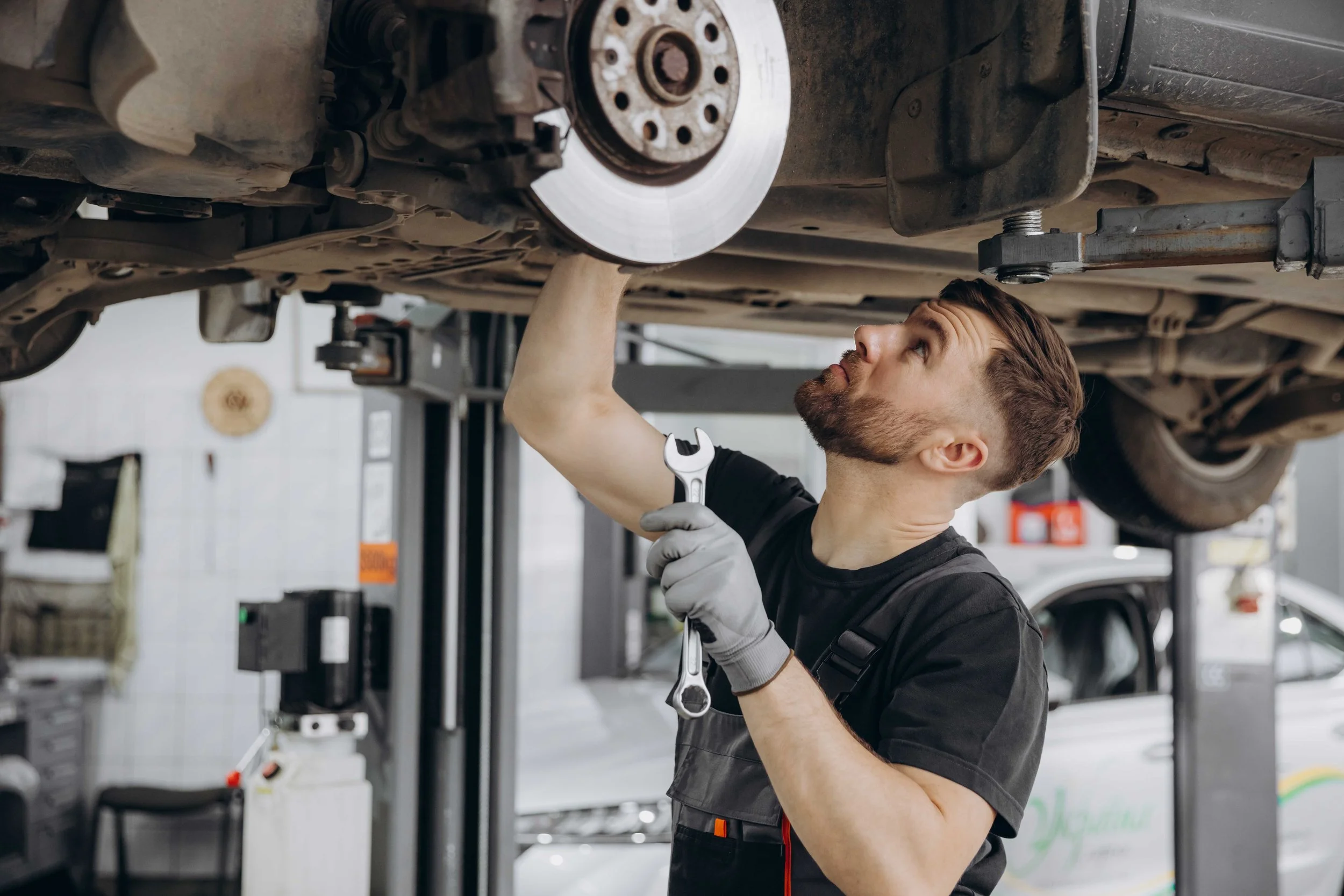
We Measure. Then We Tell You.
Brake repair in south Edmonton since 1987 — including telling
you when they have another season left.
Brake Repair in Edmonton — What It Costs and When You Actually Need It
Brakes are the repair people are most often talked into early. A shop measures four millimetres of pad, calls it urgent, and sells a job that could have waited another season. We would rather tell you where you actually stand.
A & R Automotive has been doing brake work at 2687-96 Street NW since 1987. AMVIC licensed, NAPA AutoPro, AMA/CAA approved. Call 780-468-3052 and we will measure them and tell you the truth, including when the answer is that they are fine.
What Brake Work Costs
Prices are per axle for most cars and light trucks, parts and labour included. Larger trucks and some European vehicles run higher, and we will tell you before we start.
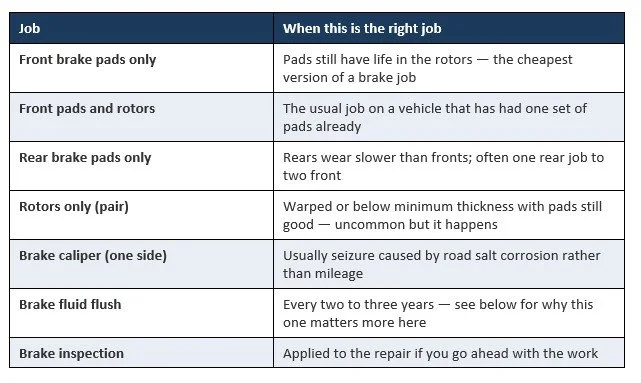
If you have been quoted somewhere else and want a second opinion, bring the quote. We will measure your pads and rotors and tell you plainly whether it is a fair number — including when it is.
Pads or Rotors — or Both?
Pads are the wearing part and get replaced every time. Rotors are the discs the pads squeeze; they only need replacing when they are worn below minimum thickness, warped, or scored.
This is the most common source of confusion in brake work and the place people most often feel they were oversold. Here is the honest version. On a first brake job, rotors are frequently still fine and pads alone will do. By the second set of pads, the rotors have usually thinned enough that fitting new pads to them is false economy — you get noise, uneven bedding and a shorter pad life. Somewhere around the second or third job, doing both is genuinely the right call rather than an upsell.
Resurfacing rotors was standard practice for years and is now rarely worthwhile. Modern rotors are made thinner to save weight, so machining them often takes them under specification. When resurfacing is a real option we will say so; most of the time it is not.
We measure rotor thickness with a micrometer and show you the reading against the minimum stamped on the rotor itself. It is a number, not an opinion, and you should expect any shop to show it to you.
What Your Brakes Are Telling You
Squealing
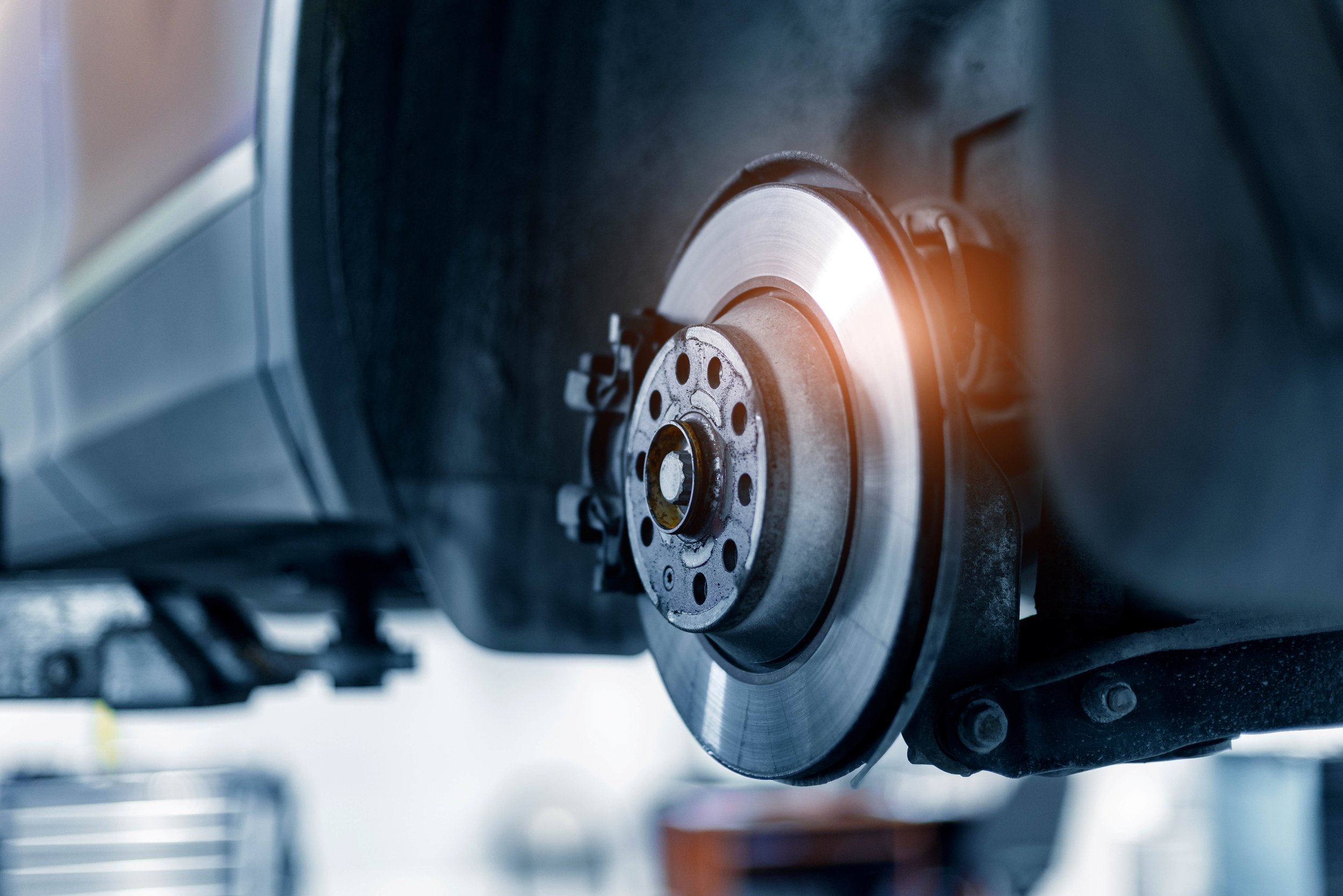
Usually the wear indicator — a small metal tab designed to contact the rotor and make exactly that noise when the pad gets low. It is doing its job. Book it in, but it is not an emergency.
Squealing can also be dust or glazing, particularly on a cold morning or after the car has sat in rain. If it disappears after the first few stops, that is what it was.
Grinding
Stop putting it off. Grinding usually means the pad is gone and you are braking on the metal backing plate against the rotor. Every stop from here is cutting into the rotor, so a pad job becomes a pad and rotor job, and if it goes far enough, a caliper job too. This is the single most expensive noise to ignore.
A pulsing or vibrating pedal
Warped rotors, or more precisely uneven deposits of pad material on the rotor face. You feel it as a rhythmic pulse through the pedal that gets worse the harder you brake. Often caused by over-torqued wheel nuts, which is why we torque wheels to specification rather than using an impact gun.
A soft or sinking pedal
This one is different from the others. A pedal that feels spongy, or slowly sinks toward the floor while you hold it at a light, points at the hydraulic system — air in the lines, a leaking wheel cylinder, a failing master cylinder, or a corroded brake line. Do not drive on it. Call us.
The car pulls to one side when braking
Usually a seized caliper on the opposite side, meaning one side is doing more of the work. Common here, and almost always corrosion rather than mileage.
The brake warning light
Either the parking brake is partly engaged, the fluid is low, or the ABS has recorded a fault. Low fluid usually means the pads have worn — as the pads thin, the caliper pistons extend and the fluid level in the reservoir drops. So a brake light and worn pads are often the same story.
Road Salt Is the Real Enemy Here
In a milder climate, brakes wear out. In Edmonton they also rust out, and that changes what brake work looks like.
Brake lines are steel and they corrode from the outside in. A line that looks fine can be thin enough to burst under hard braking, and a burst line means losing most of your stopping ability at once. We look at the lines every time a wheel comes off, and on vehicles over about ten years old we look properly rather than glancing.
Calipers seize for the same reason. The slide pins corrode, the caliper stops releasing fully, and one wheel drags — which shows up as a pull to one side, uneven pad wear, and sometimes a hot wheel and a burning smell after a drive. Caught early, it is a clean and re-lubricate. Caught late, it is a caliper.
This is also why brake fluid matters more here than the interval in your manual suggests. Brake fluid is hygroscopic — it absorbs moisture from the air — and moisture in the system corrodes lines and cylinders from the inside while lowering the boiling point. A flush every two to three years is cheap, and in a city that salts its roads for five months it is one of the few genuinely preventative jobs on a car.
How Long Do Brake Pads Last?
Anywhere from 40,000 to 110,000 kilometres, and the range is that wide because it is almost entirely about how you drive rather than what you drive.
City driving with a lot of stop-and-go wears pads several times faster than highway commuting. Towing, hills and a heavy right foot shorten it further. Front pads wear roughly twice as fast as rears on most vehicles, because the weight transfers forward under braking and the fronts do most of the work.
Rather than watching the odometer, have them measured. We check pad thickness at every oil change and tell you roughly how many months are left, so a brake job is something you plan for rather than something that ambushes you.
Ceramic or Semi-Metallic?
Semi-metallic pads bite harder and handle heat better. Ceramic pads are quieter, produce less of the dark dust that coats alloy wheels, and last longer in normal driving.
For most Edmonton drivers the honest answer is that either works and the difference is smaller than the marketing suggests. Ceramic is the better all-round choice for a commuter — quieter, cleaner wheels, longer life. Semi-metallic is worth it if you tow, drive a heavy truck, or spend time in the mountains where sustained braking builds real heat.
The one caveat worth knowing in this climate is that some ceramic compounds take slightly longer to reach their best bite from cold. On a minus-thirty morning that first stop out of the driveway can feel marginally longer. It is not dangerous and most drivers never notice, but if you are sensitive to it, semi-metallic is the more consistent choice in deep cold.
We fit NAPA parts, which carry the nationwide parts and labour warranty. If you have a preference, tell us and we will price it.
Why Have Us Do Your Brakes
Because brakes are the easiest place in this trade to be sold work you do not need, and the easiest place to be told nothing is wrong when something is.
We measure and show you the numbers — pad thickness in millimetres, rotor thickness against the stamped minimum. We tell you when you have another season. And because we are a full mechanical shop, when the pull turns out to be a suspension problem rather than a brake problem, we can just tell you that instead of selling you brakes.
Everything we fit carries the NAPA AutoPro nationwide parts and labour warranty, and we are AMVIC licensed and AMA/CAA approved.
Common Questions
-
No. On a first brake job the rotors are often still within specification and pads alone are the right job. By the second set of pads they usually need doing. We measure and show you the reading rather than asking you to take our word for it.
-
Have them measured — it takes two minutes and we do it at every oil change. Squealing means book it in soon. Grinding means today. A soft or sinking pedal means do not drive it.
-
Yes, and it is often the right call. Fronts do most of the braking and wear roughly twice as fast, so one rear job to two front jobs is a normal pattern. Always do both sides of the same axle together, though.
-
Every two to three years for most vehicles, and it matters more in Edmonton than the manual implies because moisture in the system corrodes lines from the inside while road salt attacks them from the outside.
-
Usually warped rotors, yes. If the car shakes at highway speed even when you are not braking, that is more likely a tire balance or a suspension issue. The distinction matters because they are different repairs at different prices, which is why we diagnose before quoting.
-
Often. Budget pads wear faster, are noisier, and are harder on rotors, so the cheaper job comes around again sooner. We are not going to tell you the most expensive pad is always right, but the cheapest one rarely is.
Book a Brake Inspection
Call 780-468-3052 or come by 2687-96 Street NW in South Edmonton.
Open Monday to Friday, 8:00am to 6:00pm.
If you have a quote from somewhere else, bring it — we are happy to tell you when it is a fair one.If you already know the code, have it with you — it saves us both time.